
+

Product
Solutions
Resources
Company
Partners
+

.svg)
Blog posts
Discover the power of LiDAR scanning technology and how it can level up sales.
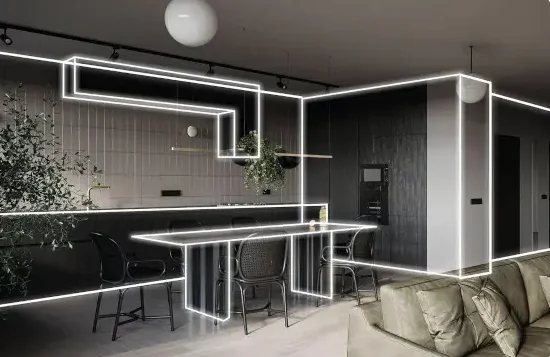
Walk into any home with a tape measure and a clipboard, and you're doing exactly what HVAC contractors have done for decades. It works. But it takes time, introduces measurement errors, and doesn't exactly wow homeowners who are comparing you to three other companies.
LiDAR changes that equation completely.
LiDAR stands for Light Detection and Ranging. The technology sends out pulses of laser light and measures how long it takes for each pulse to bounce back after hitting a surface. By calculating millions of these measurements per second, LiDAR creates detailed three-dimensional maps of spaces with remarkable accuracy.
You've probably seen LiDAR in action without realizing it. Self-driving cars use it to navigate. Surveyors use it to map terrain. Archaeologists use it to discover ancient structures hidden under jungle canopy.
What changed recently is that LiDAR moved from specialized equipment costing tens of thousands of dollars to something built into the device you might already have in your pocket.
Since 2020, Apple has embedded LiDAR sensors in iPhone Pro models (12 and newer) and iPad Pro models. This wasn't designed for HVAC contractors specifically, but it created an opportunity that didn't exist before.
Suddenly, the same technology that helps autonomous vehicles navigate city streets can help you capture room dimensions in minutes instead of hours. The sensor is already there. The question is what you do with it.
The traditional approach to gathering home measurements goes something like this: walk room to room with a tape measure, sketch dimensions on paper or a tablet, hope you didn't miss anything, and then go back to the office to input everything into your load calculation software.
That process takes one to two hours for a typical home. And while you're measuring, the homeowner is watching you do something that looks pretty much like what every other contractor does.
LiDAR flips this process entirely.
Speed without sacrifice. What used to take two hours now takes fifteen minutes or less. You're not trading accuracy for speed. LiDAR captures dimensions that are often more accurate than manual measurements because there's no human error in reading a tape or rounding numbers.
Visuals that sell. When you scan a home with LiDAR, you're not just getting measurements. You're creating a 3D model of that specific house. Show a homeowner a three-dimensional rendering of their own home with equipment placement visualized, and you've done something no competitor with a tape measure can match.
Load calculations on site. Because LiDAR captures walls, windows, doors, and room dimensions simultaneously, you can run a complete Manual J calculation while you're still in the home. No second visit to present options. No waiting for someone back at the office to crunch numbers. The homeowner gets answers the same day, which means decisions happen faster.
Custom sales materials. Every presentation you create includes actual images of that homeowner's space. Floor plans generated from the scan. Equipment placement shown in context. This isn't a generic brochure with stock photos. It's their home, with your solution designed specifically for it.
The benefits don't stop when the sale closes. Everything you captured during the sales process becomes documentation for your install team.
Accurate measurements for materials. Line sets, conduit runs, ductwork lengths. When your sales team hands off a job with LiDAR-generated floor plans, the install crew knows exactly what they're walking into. No surprises about room layouts or dimensions.
Visual context before arrival. Instead of relying on notes and sketches, installers can review a 3D model of the space before they even pull up to the job site. They know where equipment goes, how rooms connect, and what access points look like.
Right-sized systems. Because the load calculation came from accurate dimensional data, the equipment your team installs actually matches what the home needs. Fewer callbacks from comfort complaints. Fewer warranty claims from oversized systems short-cycling themselves to death.
Even if you didn't install the original system, LiDAR-equipped tools give your service team capabilities that weren't practical before.
When a technician walks into a home to evaluate an existing system, they can capture the entire space in minutes. Room-by-room airflow analysis becomes feasible on a service call. Replacement system sizing doesn't require a separate sales visit.
Your service technicians can identify opportunities and gather the data needed to design the right replacement system on the spot. That speeds up the path from service call to sold job.
Time is the enemy of sales. Every day between your visit and the homeowner's decision is another day for competitors to show up, for urgency to fade, and for doubt to creep in.
When you can walk into a home, scan the space, run a load calculation, and present options in a single visit, you compress the entire sales cycle into one appointment. The homeowner doesn't have to wait for a proposal. They don't have to schedule a follow-up. They can make a decision while you're still there and the problem is fresh in their mind.
Contractors using LiDAR-based tools consistently report higher close rates. Not because the technology itself sells anything, but because it enables a faster, more impressive, more professional sales process.
Getting the job done right the first time isn't just good customer service. It's good business.
Properly sized equipment runs efficiently, maintains comfort, controls humidity, and lasts longer. Homeowners don't call back complaining that rooms are too hot or too cold. They don't wonder why their energy bills are higher than promised. They refer their friends because everything works exactly like you said it would.
Manual measurements introduce errors. Maybe you misread the tape. Maybe you forgot to measure a window. Maybe your sketch didn't quite capture how rooms connect. Those small errors compound into load calculations that are close but not quite right.
LiDAR doesn't get tired. It doesn't round numbers. It captures everything in the scan area whether you remembered to measure it or not. The result is dimensional data you can trust.
Most HVAC contractors are still using tape measures and paper. Some have moved to laser distance measurers. Very few have adopted LiDAR-based workflows.
That gap won't last forever. Technology adoption in this industry tends to happen slowly, then all at once. Right now, showing up with LiDAR capability puts you ahead of the vast majority of competitors.
Homeowners notice when your process looks different. When you're building a 3D model of their home in real time instead of scribbling on a clipboard, it signals that you're a different kind of contractor. That perception matters when they're deciding who to trust with a significant investment in their home.
If you have an iPhone Pro or iPad Pro from the last few years, you already have the hardware. The LiDAR sensor is built in.
What you need is software that turns that sensor into an HVAC workflow tool. Something that captures the scan, generates floor plans, feeds measurements into load calculations, and produces the reports and visuals that make your sales process stand out.
That's exactly what Conduit Tech was built to do. Our platform takes the LiDAR capability in your existing device and turns it into a complete system design and sales tool. Scan the home, run the load calc, present options, close the deal. All in one visit.
Ready to see what LiDAR can do for your business? Book a demo and experience the difference yourself.
.svg)


Copyright 2025 Conduit Tech, LLC. All rights reserved. Terms and Conditions Privacy Policy
Your Privacy Choices Do Not Sell or Share My Personal Information