
+

Product
Solutions
Resources
Company
Partners
+

.svg)
Blog posts
Discover how the HVAC sales landscape is transforming with the adoption of new technologies. In this video, "HVAC Sales: Old School vs. New School," you'll learn about the shift from traditional sales methods to modern strategies that leverage digital tools, data analytics, and streamlined processes. Enhance your sales approach, engage customers more effectively, and increase conversion rates by embracing these innovative techniques.
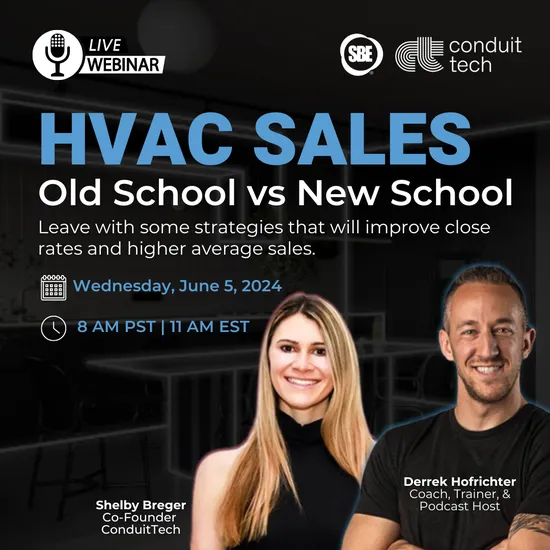
What worked 10 years ago isn't working today. Here's what's changed and what the top performers are doing differently.
The door-to-door vacuum salesperson doesn't exist anymore.
Think about that for a second. There was a time—not that long ago—when someone could knock on your door unannounced, somehow get invited inside, run a demonstration, and walk out with a sale for an overpriced vacuum that nobody woke up that morning planning to buy.
That approach is dead. And yet a lot of HVAC sales processes still operate on the same fundamental principles.
If your close rates are declining, your follow-up list is growing, and you're losing to competitors even when you know your solution is better—the problem might not be your pricing or your product. It might be that you're running an old school playbook in a new school market.
Old school sales puts the salesperson at the center. The thinking goes: if you're skilled enough, charismatic enough, and have memorized enough closes and objection handlers, you can sell anything to anyone.
Here's what that looks like in practice:
Artificial urgency. Pushing customers to make decisions on your timeline, not theirs. Creating pressure through limited-time offers and manufactured scarcity.
Scripted presentations. Same pitch, same one-liners, same jokes, same stories for every customer. The brochure does the talking. Get them off-script and the whole thing falls apart.
High pressure. The assumption that customers need to be convinced, persuaded, overcome. Sales as a battle to be won.
Impersonal approach. Copy and paste. Same solution presented the same way regardless of what the customer actually needs.
Fake rapport building. "Oh, you like golf? My neighbor's uncle loves golf!" Bonding that feels forced because it is forced.
Win-lose mentality. For you to win, the customer has to lose. Wolf of Wall Street. Always be closing. Sales as combat.
The old school model worked when customers had limited information and limited options. It worked when you could interrupt someone's day and they had no choice but to listen. It worked when getting three quotes meant three phone calls and waiting a week.
That world doesn't exist anymore.
Two major inflection points reshaped how people buy.
2008: The housing crash, the rise of Amazon, the emergence of companies like CarMax. Suddenly customers had options. They could research before they bought. They could compare without leaving their couch. The last car many people bought, they purchased entirely online—it showed up in their driveway.
Post-COVID: Another acceleration. Customers became even more comfortable researching online, getting multiple quotes, and waiting for the right fit. The economy tightened. Election cycles made people cautious. Multiple estimates became the default, not the exception.
Here's the reality now: most homeowners are going to get multiple quotes. That's just how it works. And if you're running the old school playbook—the same scripted presentation that everyone else is running—you're going to get drowned out.
You have to stand out. You have to be different.
New school sales puts the problem at the center. The focus shifts from "how do I close this person" to "how do I solve this person's specific problem."
Uncovering existing urgency. Instead of creating artificial pressure, you discover what timeline the customer already has. HVAC customers usually have some urgency—something broke, something's uncomfortable, something's costing them money. Your job is to understand it, not manufacture it.
Process with adaptability. You follow a consistent process, but you're not locked into a script. You adapt based on what you're hearing. What worked last summer might not work this summer. What worked last week might not work this week.
Helpful instead of high pressure. The goal is to genuinely help, not to overcome. When customers feel helped instead of pushed, they stop putting up defenses.
Specific and custom. Every solution is tailored to what this particular customer needs. You've done your homework. You've researched the house. You've called ahead. You understand their situation before you show up.
Conversation instead of presentation. You ask questions. You listen. You get permission before you present. The customer feels like they're collaborating with you, not being sold to.
Same team mentality. It's not you versus them. You're on the same side, working toward the same goal: finding the right solution for their home.
Old school sales rewarded memorization, persistence, and the ability to power through objections. New school sales rewards a different set of capabilities.
Emotional intelligence. The ability to read the room. To sense when to push forward and when to hold back. To understand what's actually important to the customer, not what you assume is important.
Authenticity. Fake rapport triggers defenses. Customers can detect when you're being genuine versus when you're running a technique. Authenticity builds trust. Techniques build walls.
Curiosity. This one is hard to teach, which is why it's worth looking for when hiring. Curious salespeople ask "why" and "what else" and "tell me more." They genuinely want to understand the situation, not just gather enough information to launch their pitch.
Competency. Knowing the newest equipment, the newest technologies, the newest approaches. Customers trust people who seem competent. Competency comes from staying current.
Adaptability. Being coachable. Being willing to change what's not working. Recognizing that your experience can become baggage if you let it calcify into "this is how it's done."
Critical thinking. No script works for everyone. You have to think on your feet and construct solutions in real time based on what you're learning.
Problem solving. Instead of "closing," you're solving. You're using everything you've learned in the conversation to build a solution that's exactly what the customer needs—and that they trust you to deliver.
Here's something uncomfortable that sales coaches see regularly: a 22-year-old with no HVAC experience and no sales background sets the company sales record in their first year.
It's frustrating for veterans who've been doing this for decades. But it makes sense when you understand what's happening.
New salespeople don't have limiting beliefs. They don't "know" that certain things won't work because they've never been told they won't work. They pick up the new tools, the new process, the new approach and just use them. Fully committed. No baggage.
They don't have to unlearn the old school habits. They never learned them in the first place.
Veterans who are willing to approach things with that same beginner's mindset—who can set aside "how it's always been done" and genuinely commit to a new approach—see the same results. But it requires acknowledging that experience can be a liability if it's preventing you from adapting.
The biggest obstacle to adopting new methods isn't fear of change. If you won the lottery tomorrow, you wouldn't be afraid of that change. You'd embrace it.
The real obstacle is the worry that you're losing something. That in exchange for trying something new, you're giving up something that works. Something comfortable. Something known.
That worry is usually unfounded. But it feels real, and it keeps people stuck.
The other obstacle is limiting beliefs. Things you believe are true that aren't actually true—but because you believe them, you make them true for yourself.
"Customers don't want to see all that technology stuff."
"This would never work with my customers."
"The old way is more personal."
If you believe these things, you'll find evidence to support them. You'll hold back on the new approach, do it half-heartedly, and point to the mediocre results as proof that you were right all along.
The salespeople who thrive don't have these blocks. They try things fully, measure the results, and adjust based on data rather than assumptions.
Companies that successfully shift to new school methods report consistent patterns.
Closing on the first visit. Instead of the endless follow-up game, they're giving homeowners everything they need to make a decision while they're still at the kitchen table. The homeowner has the information, they trust the solution, they move forward.
Winning against multiple bids. Even when they're the most expensive quote—sometimes especially when they're the most expensive quote—they're winning. Because their process is so different, so professional, so obviously thorough that customers choose them over cheaper alternatives.
Cutting follow-up dramatically. The follow-up game burns out more salespeople than anything else. When you're closing more on the first visit, your follow-up list shrinks. Your time opens up. Your stress drops.
Standing out in a crowded market. When everyone else is running the same scripted presentation, the contractor who shows up with a custom solution, backed by data, presented through modern tools—that contractor looks like a completely different category.
New school sales methods increasingly involve new technology. Not because technology is magic, but because technology enables the things that new school sales requires.
Customization at scale. Showing instead of telling. Documentation that builds trust. Speed that respects the customer's time while demonstrating thoroughness.
Tools like LiDAR scanning, 3D modeling, on-site load calculations, AI-assisted coaching—these aren't gimmicks. They're how you deliver a genuinely custom solution in a single visit. They're how you stand out from the contractor with a clipboard and a rule-of-thumb estimate.
The companies that are thriving right now are the ones that view technology adoption not as an expense or a hassle, but as a competitive advantage. They find one person on the team who's excited to try it, let them run with it, measure the results, and use that proof to bring others along.
The market has changed. Customers have changed. The contractors who are winning are the ones who've changed with them.
Old school sales—the scripted presentations, the artificial urgency, the high-pressure closes, the adversarial win-lose mentality—doesn't work like it used to. The follow-up lists get longer. The close rates drop. The frustration builds.
New school sales—the curiosity, the customization, the collaboration, the technology-enabled differentiation—is how top performers are thriving even in a difficult market.
The question isn't whether to adapt. The question is whether you'll adapt now, while it's still a competitive advantage, or later, when it's table stakes and everyone else has already caught up.
Conduit Tech helps HVAC contractors stand out on-site with LiDAR-powered load calculations, 3D models, and professional presentations—all in a single visit. Book a demo to see how the platform supports new school sales.
.svg)


Copyright 2025 Conduit Tech, LLC. All rights reserved. Terms and Conditions Privacy Policy
Your Privacy Choices Do Not Sell or Share My Personal Information