
+

Product
Solutions
Resources
Company
Partners
+

.svg)
Blog posts
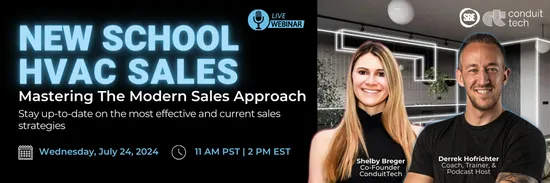
Mastering modern sales techniques is essential for staying competitive. The "New School HVAC Sales: Mastering the Modern Sales Approach" webinar offers practical insights into enhancing sales skills, boosting performance, and improving customer engagement.
Today's homeowners are different. They've done their research before you arrive. They're skeptical of scripted pitches. They can spot a closing technique from a mile away. And they have more options than ever before.
The old playbook of interrupting, overcoming objections, and pushing for the close doesn't work like it used to. It creates follow-up. It creates resistance. And it often leaves money on the table.
We recently partnered with Derek from SBE, a coaching and training company focused on residential HVAC, to explore what separates modern, effective sales approaches from the methods that are holding contractors back. What emerged was a clear framework for rethinking how sales conversations should unfold.
Old school sales has a predictable feel. It's scripted. It's character-driven, where the salesperson puts on their "sales hat" and becomes someone else. It's focused on flushing out objections and then overcoming them one by one. And when it doesn't work, it creates mountains of follow-up.
New school sales looks completely different. It starts with qualifying leads and prepping for specific customers. It gets permission at each step rather than pushing forward. It asks questions to uncover what the customer actually wants, when they want it, and what's standing in the way. And it focuses on being genuinely different from everyone else who walks through that door.
The shift isn't just tactical. It's philosophical. Old school treats sales as something you do to someone. New school treats it as something you do with someone.
One of the most influential books on modern sales is To Sell Is Human by Daniel Pink. The author spent time observing sales in different environments, from used car lots to Best Buy floors, and identified what actually works in today's world.
His findings align perfectly with what successful HVAC contractors are doing differently. Modern sales requires focusing on service, understanding the customer's perspective, and helping them see their problems clearly. Any pitch needs to be short and extremely interactive. Improv skills matter more than scripts. And the best salespeople overcome objections before they ever come up.
That last point is the one that changes everything.
Here's the insight that transforms sales results: if you bring up potential concerns first, they're conversations. If the customer brings them up at the end, they're objections.
Think about the common objections that derail sales. They typically fall into five categories: logistical concerns, timeline issues, decision-maker questions, motivational hesitation, and financial considerations.
Most salespeople fear financial objections the most. But here's the surprising truth: financial objections are actually the easiest to address because you have options. You can adjust the system. You can offer financing. You can modify the scope.
The objections that kill deals are the first four. When a customer says "I need to talk to my partner" at the end of a presentation, there's almost nothing you can say that won't come across as pushy. That conversation needed to happen at the beginning, not the end.
The solution is simple in concept but requires practice in execution. Ask about potential concerns upfront, before you've done the estimate, before you've put together pricing, before there's anything to close on.
For logistical concerns, ask something like: "Have you had estimates done for this before, or is this your first time going through buying a new system?" This opens the door to understanding their expectations and any past experiences that might be shaping their thinking.
For timeline issues, try: "Whether we install the system for you or you go with someone else, when do you need this completed by?" Now you're uncovering their actual timeline rather than proposing something that might not fit.
For decision-maker questions: "Usually for big projects like this, there are multiple decision makers involved. Are we missing anyone?" If someone else needs to be part of the conversation, you want to know that now, not after you've finished your presentation.
For motivational concerns: "What would be the perfect outcome for you from today's meeting?" This reveals whether they're ready to make a decision or just gathering information.
For financial considerations: "I know this is a big project, and most of the customers I work with are responding to their system's timeline, not necessarily their own money timeline. Is this a project you've been saving up for?" This opens a money conversation before it becomes a money objection.
When you ask these questions at the beginning, the pressure is off. There's nothing to close yet. You're just having a conversation. And that's exactly the point.
These questions only work if they come from genuine curiosity. Customers can tell the difference between someone who's checking boxes and someone who actually wants to understand their situation.
The tone matters enormously. There's a difference between asking "How many quotes have you gotten?" in a way that sounds judgmental versus asking "Have you had estimates done before?" in a way that's genuinely interested in their experience.
The best salespeople operate from what communication experts call a "nurturing parent" state. Non-judgmental, supportive, focused on helping. They recognize that no one wants to be replacing their HVAC system. It's expensive, it's disruptive, and it's not how anyone wants to spend their money.
When you approach sales from that place of empathy and curiosity, everything changes. You're not trying to convince anyone of anything. You're trying to understand their situation and see if you can help.
Consider what the experience looks like from the homeowner's perspective. They're getting three quotes. If all three salespeople ask the same questions, do the same walkthrough, and deliver the same type of estimate, how does the homeowner decide?
When everything feels the same, price becomes the only differentiator. And that's a race to the bottom that nobody wins.
But if one salesperson asks completely different questions, shows genuine curiosity about their specific situation, uses technology to create an interactive experience, and delivers recommendations that clearly reflect everything the customer said, that's a completely different decision.
Now it's not "which of these three similar options is cheapest." It's "there was this one, and then there were all the others."
Part of being different is using tools that elevate the customer experience. Running a proper load calculation on-site, showing homeowners a 3D model of their home, walking them through exactly why you're recommending what you're recommending, these things create an experience that most competitors simply can't match.
The goal isn't just efficiency, though completing the entire sales process in one visit certainly helps. The goal is engagement. When customers participate in the process, when they see the data behind your recommendations, when they understand the "why," they trust the outcome.
That trust is what separates a sale from a five-star review with no purchase. Everyone has had that experience where the customer says "You were the most knowledgeable person I talked to" and then goes with someone else. Knowledge alone doesn't close deals. Trust does.
Adopting a new sales approach isn't something that happens overnight. It requires practice, coaching, and a culture that supports continuous improvement.
The best sales organizations create environments where learning is celebrated. They have book clubs where teams read and discuss sales books together. They do role plays to practice new techniques. They share what's working and what isn't. They bring in coaches to identify blind spots.
They also hire for curiosity from the start. Some interview processes even include exercises designed to reveal whether candidates are naturally curious or not. Because curiosity isn't something you can fake, and it's not something you can easily teach.
As you implement new approaches, track the metrics that tell the full story. Close rates and average ticket sizes matter, but they don't reveal everything.
Pay attention to your sales cycle. How long does it take from the initial estimate to the closed sale? Extended sales cycles often indicate that something is missing from the initial conversation, that the customer needed information or assurance they didn't get.
Track referrals. When customers are genuinely happy with their experience, they tell their neighbors. When they're not, even if they bought from you, they don't. The number of referrals your team generates is one of the clearest indicators of whether your sales process is creating satisfied customers or grudge purchases.
Modern HVAC sales isn't about being pushy or mastering objection-handling scripts. It's about curiosity, collaboration, and creating an experience that's genuinely different from what everyone else is offering.
When you go first on the hard conversations, bring genuine curiosity to every interaction, and use technology to make the experience interactive and engaging, you stop competing on price and start winning on value.
That's the new school approach. And it's what separates the contractors who are thriving from the ones who are struggling to figure out why their old methods aren't working anymore.
Ready to see how technology can transform your sales process? Schedule a demo to learn how Conduit Tech helps contractors deliver an experience that stands out from the competition.
.svg)


Copyright 2025 Conduit Tech, LLC. All rights reserved. Terms and Conditions Privacy Policy
Your Privacy Choices Do Not Sell or Share My Personal Information