
+

Product
Solutions
Resources
Company
Partners
+

.svg)
Blog posts
Learn more about heat gains in your home with this quick video covering the essentials.
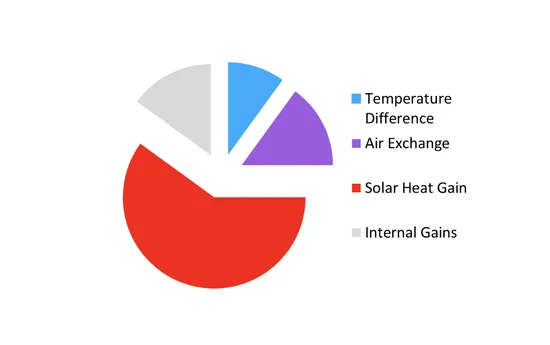
When sizing cooling equipment, heat gain calculations determine everything. Get them wrong and you end up with a system that short cycles, can't dehumidify, or simply can't keep up on the hottest days of summer.
The good news is that not all inputs carry equal weight. Understanding which factors move the needle most helps you focus your attention where it matters and avoid getting lost in details that barely change the outcome.
Looking at what actually drives cooling loads in residential buildings, two categories dominate: solar heat gain and internal gains.
Everything else matters too. Conduction through walls, infiltration, ventilation loads. But if you want to get your heat gain calculation close to right, nail the solar and internal gain inputs first.
Solar heat gain through windows accounts for a massive portion of cooling load in most homes. The sun doesn't care what your thermostat says. When it's shining through glass, it's adding heat to the space.
Several factors determine how much solar heat gain you're dealing with:
Window orientation: South and west-facing windows collect the most solar heat. West is particularly brutal because afternoon sun hits when outdoor temperatures are already at their peak. A house with big west-facing windows needs significantly more cooling capacity than the same house with those windows facing north.
Window area: More glass means more solar gain. Simple math, but often underestimated. That wall of windows in the great room isn't just an aesthetic choice. It's a load calculation input that can swing your cooling requirement by thousands of BTUs.
Glass type: Not all windows perform the same. Single pane, double pane, low-E coatings, tinted glass, reflective films. Each has different solar heat gain coefficients. A low-E window might cut solar gain in half compared to clear single pane. If you don't know what's installed, your calculation is guessing.
Shading: Overhangs, awnings, trees, neighboring buildings. External shading dramatically reduces solar gain. A window that's fully shaded performs completely differently than one in direct sun. Internal shading like blinds and curtains helps too, but not as much as blocking the sun before it hits the glass.
When you're walking through a home, pay attention to the windows. Note their orientation, estimate their size, look at what type of glazing is installed, and observe what shading exists. This is where your cooling load calculation lives or dies.
People, appliances, and lights all add heat to a home. This is internal gain, and it's the second major driver of cooling loads.
Occupants: Every person in the home adds roughly 230 BTUs per hour of sensible heat, plus latent heat from respiration and perspiration. A family of four adds nearly 1,000 BTUs per hour just by existing. More people means more load.
Appliances: Kitchens are heat factories. A gas range, oven, refrigerator, and dishwasher all reject heat into the space. Laundry equipment adds load. Even the TV and computers contribute. Manual J provides standard values for typical appliance loads, but homes with professional kitchens or lots of electronics might exceed those assumptions.
Lighting: Every watt of lighting eventually becomes heat. LED bulbs produce less heat than incandescent, but they still contribute. Recessed can lights in an insulated ceiling are particularly problematic because the heat has nowhere to go but into the conditioned space.
The kitchen and living areas where people gather typically have the highest internal gains. Bedrooms and bathrooms have lower loads because people spend less active time there and there are fewer heat-producing appliances.
Solar gain and internal gains matter more than other factors because they represent heat being added directly to the space, not conducted through insulated assemblies.
A wall might have R-13 or R-19 insulation slowing down heat transfer. A ceiling might have R-38 or more. These building components resist heat flow. The temperature difference between inside and outside has to push through that resistance.
But sunlight coming through a window? That's direct radiation hitting floors, furniture, and walls, then converting to heat inside the conditioned space. No insulation in the way. Same with internal gains. That heat is generated inside the envelope with nowhere to go but into your load calculation.
This is why two homes with identical square footage, insulation levels, and construction quality can have wildly different cooling loads. One has modest north-facing windows and minimal glazing. The other has a sunroom with floor-to-ceiling south and west glass. The building envelope might be identical, but the cooling requirements aren't even close.
When you're doing a load calculation, spend your time where it counts:
Measure windows carefully. Don't estimate. Get actual dimensions for every window, note which direction they face, and identify the glazing type if possible.
Observe shading conditions. A window that's shaded at 10am might be in full sun at 3pm. Think about what happens during peak cooling hours, not just when you happen to be there.
Ask about occupancy. How many people live in the home? Do they work from home? Do they entertain frequently? Standard assumptions work for standard situations, but not every home is standard.
Note unusual heat sources. Home offices with multiple monitors and computers. Hobby rooms with equipment. Home gyms. These spaces have higher internal loads than typical rooms.
The envelope details matter too. You still need accurate insulation values, infiltration estimates, and construction characteristics. But if you're short on time and need to prioritize, focus on solar and internal gains first. That's where the cooling load lives.
Conduit Tech captures window details during the scanning process and factors orientation, size, and shading into your load calculations automatically. See how it works.
.svg)


Copyright 2025 Conduit Tech, LLC. All rights reserved. Terms and Conditions Privacy Policy
Your Privacy Choices Do Not Sell or Share My Personal Information