
+

Product
Solutions
Resources
Company
Partners
+

.svg)
Blog posts
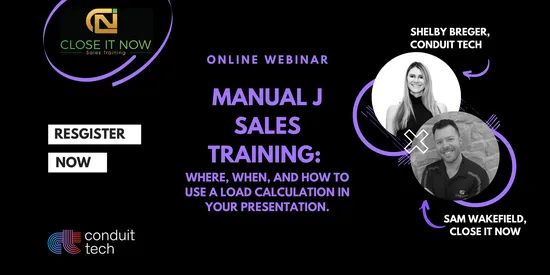
Learn the ins and outs of where, when and how to use a load calculation in your presentation!
The number of HVAC contractors who have stopped using Manual J calculations in their sales presentations is honestly staggering. What was once standard practice has fallen off dramatically over the past decade, and a lot of that comes down to one thing: sales got too easy during the pandemic boom.
Now that the market has shifted and homeowners are getting five, eight, even ten quotes before making a decision, contractors are scrambling to figure out how to stand out. The answer might be something you used to do all along.
The traditional way of running a Manual J was painful. Walking through every room with a tape measure, writing down dimensions, spending 30 to 45 minutes on calculations while the homeowner sat bored at the kitchen table. The old training advice was to hand the homeowner the "dumb end" of the tape measure and have them read numbers while you wrote them down.
Twenty years ago, that impressed people. It showed thoroughness and attention to detail.
Today, it does the opposite. The homeowners who grew up with smartphones and instant answers see that process as outdated and inefficient. Walking through a house with a tape measure for 45 minutes actually unimpresses people under 50 because they expect technology to work faster than that.
This mismatch between old processes and modern expectations is exactly why so many contractors gave up on load calculations entirely. The juice didn't seem worth the squeeze when sales were flowing in anyway.
Before getting into the sales technique, there's a cautionary tale every contractor needs to hear.
One company did everything right on a project. Ran the Manual J, sized the system perfectly, installed a high-efficiency variable speed unit. Everything worked great for the first month. Then the homeowners decided to turn their home into a rainforest, adding so many plants that humidity levels went through the roof. When the system couldn't keep up with the changed environment, they blamed the contractor.
The homeowner happened to be an attorney. He sued.
Three years and roughly $300,000 in legal fees later, the judge threw it out of court. The contractor had documentation proving they followed proper procedures. The homeowner had denied the recommended solution of adding a dehumidifier. The judge actually ordered the homeowner to pay the contractor's legal fees.
That documentation existed because they ran a proper load calculation.
Without that Manual J, the company would have had nothing to prove they sized the system correctly. No defense against the claim that they installed the wrong equipment. Plenty of contractors have closed their doors permanently over exactly this kind of lawsuit.
The load calculation doesn't belong at the beginning of your appointment. It goes during your walkthrough, after you've done introductions, set an agenda, and completed your discovery questions.
Here's why timing matters. The average North American homeowner buys 1.3 HVAC systems in their lifetime. That means most people have never done this before and will never do it again. They have zero frame of reference for what a good sales process looks like. All that uncertainty about making a decision, the feeling that they need to get three or five or ten bids, the lack of urgency you're seeing in the market right now, it all stems from that unfamiliarity.
Your job is to reduce that uncertainty by walking them through exactly what you're doing and why each step matters. The Manual J becomes powerful when you introduce it properly, take them on the journey with you, and show them the results in a way that builds their confidence.
The introduction matters more than the calculation itself. If you just start measuring without explaining what you're doing, you might as well not do it at all. The homeowner won't understand the value of what they're watching.
Start by asking permission. Something like: "Before we look at options, I need to run some calculations on your home to make sure we're looking at the right size system. Is it okay if I explain why this is so important?"
They'll say yes. Then you connect the concept to something they already understand.
"Sizing an air conditioner is kind of like sizing pants. You don't want them too small, you don't want them too big. They've got to fit just right. Same thing with your cooling system."
From there, connect to whatever comfort issues they mentioned during discovery. If they told you their bedroom is always warmer than the rest of the house, tie that back. "Remember how you mentioned it never feels as cool in here as you want even when the thermostat says 73? That's actually what happens when a system is oversized. It gets to temperature so fast that it never runs long enough to pull humidity out of the air."
Then drop the knowledge that surprises most homeowners: the number one purpose of an air conditioner isn't to cool the house. It's to dehumidify. Pulling moisture out of the air is what makes it feel comfortable. An oversized system short cycles before it can do that job properly.
Here's where you leverage outside authority to reinforce why this matters. Consumer Reports has published extensively on HVAC installation, and their recommendations align perfectly with what you're doing.
Pull up the article or have it printed. Show them the section that says the most important aspect of an AC installation is finding the right contractor. Point to where it explains that contractors should calculate loads using Manual J. Read them the line that says to be wary of any contractor who bases estimates merely on house size or vague rules of thumb.
When the homeowner inevitably mentions that the last company who came through didn't do any of this, you have your opening.
"Sadly, it's the 80/20 rule like any industry. There are excellent companies out there, but 80% are not so excellent. Could be laziness, could be lack of training, could be they just think they know better than the math. Whatever the reason, anyone skipping these steps is cutting corners. And if they're cutting corners on the calculation, what else are they cutting corners on during the install?"
You're not talking bad about a specific competitor. You're establishing a standard and letting the homeowner draw their own conclusions about companies that don't meet it.
One of the most effective techniques for building buy-in happens before you ever start the load calculation. During your discovery questions, ask if you can take some notes. Write down every concern, every comfort issue, every hot button they mention.
Then at the end of discovery, hand them the paper and your pen. Ask them to prioritize the list from most important to least important.
The second their hand touches that paper, something shifts. They're no longer evaluating your proposal. They're helping design it. The project becomes partly theirs because they participated in creating it. And it's much harder to say no to something you helped build than something that was presented to you fully formed.
Most homes have oversized HVAC systems. Most ductwork is undersized. This combination means your properly calculated recommendation will often come in half a ton or more below what's currently installed and what competitors are quoting.
Homeowners get confused when five companies say they need a 5-ton system and you're recommending a 3.5-ton. Without proper setup throughout the appointment, that becomes an objection that's hard to overcome.
The solution is building buy-in at every step of the sizing process. They watched you scan or measure the house. They saw the software model their specific home. They understand why oversizing causes humidity problems. They know Consumer Reports recommends this exact process.
By the time you present your recommendation, they've been part of the journey. The smaller system size isn't a surprise that contradicts everyone else. It's the logical conclusion of everything you've shown them.
And when that system gets installed and they call you to say they've never been more comfortable in their home, that's the payoff for doing this right.
Your confidence transfers to the homeowner. Your certainty about the right solution becomes their certainty about choosing you. But that transfer only happens when you can show undeniable proof of what you're doing.
Take pictures in the attic. Shoot video of the problems you find. When you come back down, walk them through exactly what you saw. "Remember we talked about that bedroom that's always warm? I found a couple things in the attic causing that. Want to see what I found?"
Show them the disconnected ductwork. Play the video of insulation blowing around from air leaks. Then connect it directly to their problem. "See how this duct is completely separated? Every time your system runs, you're basically cooling your attic instead of that bedroom. It's like leaving your refrigerator door open all day."
The same approach applies to your load calculation results. The homeowner doesn't need to understand the math. They need to see that you understand the math and that technology validated your conclusions. When they watch their home get modeled in real time and see the calculation happen instantly, their confidence in the recommendation goes up dramatically.
Since this comes up constantly, here's a practical guide for selecting infiltration levels when you don't have a blower door test.
ACCA Manual J defines five levels based on air changes per hour. Without testing equipment, you're making visual assessments based on building age and condition.
Houses built in the last 20 years with no major upgrades generally fall into average infiltration. Anything older than 25 years without significant weatherization work is loose or very loose. You'll almost never have a tight or semi-tight house unless it's brand new construction or has spray foam encapsulation.
Look for cracks around door and window frames. Feel for drafts at intersections where different materials meet. Notice dust accumulation patterns. The more issues you observe, the looser the home.
In states with strong weatherization programs like New York and Massachusetts, ask if the home has had an energy audit. Sometimes homeowners have that documentation available, which gives you better data for your inputs.
Manual J isn't just a technical requirement or a liability protection measure. It's one of the most powerful differentiation tools available to HVAC contractors in a crowded market. When homeowners are collecting double-digit quotes and everyone else is just eyeballing square footage, the contractor who shows up with technology, takes them through the process, and proves they're sizing the system correctly stands apart from the competition.
The contractor in Oregon who was the eleventh quote at twice the price of every competitor still got the job. Why? Because nobody else had even offered to do what he did. They assumed the homeowner wouldn't pay for it, so they never gave them the chance.
Don't leave that opportunity on the table.
.svg)


Copyright 2025 Conduit Tech, LLC. All rights reserved. Terms and Conditions Privacy Policy
Your Privacy Choices Do Not Sell or Share My Personal Information