
+

Product
Solutions
Resources
Company
Partners
+

.svg)
Blog posts
Discover the essential tips to ensure a comprehensive ductwork evaluation.
Ductwork doesn't get the attention it deserves in load calculations. Most contractors focus on equipment sizing and building envelope characteristics, but the condition of the duct system directly affects how much heating and cooling capacity you actually need.
Leaky ducts don't just waste energy. They change the math on your Manual J.
When return ducts leak in an unconditioned space like an attic or crawlspace, you're pulling in air from places you don't want it. That attic air in the summer might be 130°F. That crawlspace air in the winter might be 40°F and damp. Your system now has to condition that air on top of the normal load.
Supply leaks create a different problem. Conditioned air that was supposed to reach the living space ends up in the attic or basement instead. The house can't maintain temperature, and the system runs longer trying to keep up.
Both scenarios increase the effective load on the system. A house with significant duct leakage needs more capacity to achieve the same comfort level as a house with sealed ducts.
Beyond load calculations, leaky ducts create infiltration problems. Supply leaks pressurize the attic while return leaks depressurize the living space. That pressure imbalance pulls unconditioned air through every gap in the building envelope, making infiltration worse than it would be otherwise.
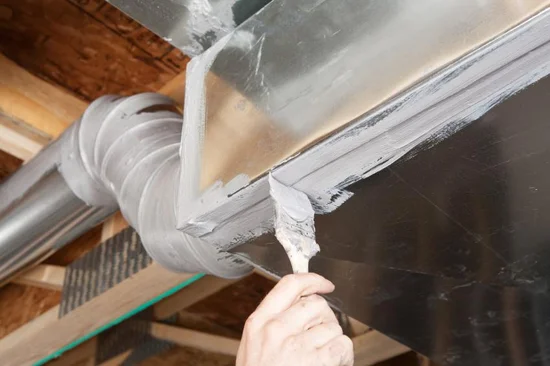
Properly sealed ductwork isn't complicated, but it's frequently done wrong or not done at all.
Flex duct connections: Every connection point needs to be sealed. Where flex meets a takeoff, where it connects to a boot, where it joins to a plenum. Mastic or approved tape at every joint.
Boot connections: Boots should be sealed to the ceiling or floor they penetrate. This does two things. It prevents conditioned air from leaking into the unconditioned space, and it reduces infiltration into the home by sealing that penetration.
Hard pipe joints: Sheet metal ductwork needs the same attention. Longitudinal seams, transverse joints, and connections to fittings should all be sealed.
Insulation: Ducts in unconditioned spaces need adequate insulation to prevent thermal losses. A sealed duct that's poorly insulated still costs you capacity through conduction.
When you're on site doing a load calculation, take time to actually look at the ductwork. A quick visual inspection tells you a lot.
In the attic:
In the basement or crawlspace:
At the equipment:
Your load calculation software typically has inputs for duct leakage or duct condition. What you observe during inspection determines what you select. Marking "sealed" when the ductwork is clearly leaking gives you an inaccurate load and leads to undersized recommendations.
Duct leakage ties directly into ventilation requirements. When a house is tight (below 5 air changes per hour), mechanical ventilation becomes mandatory. The building isn't getting enough fresh air through natural infiltration, so you have to bring it in intentionally.
Leaky ducts in a tight house create a worst-of-both-worlds scenario. The envelope is tight enough to trap pollutants and moisture inside, but the duct leaks are pulling contaminated air from attics and crawlspaces instead of fresh outdoor air. Indoor air quality suffers even though you're technically getting "ventilation."
The right approach is sealed ducts combined with designed ventilation. ASHRAE 62.2 specifies how much fresh air a home needs based on square footage and number of bedrooms. Good Manual J software will calculate ventilation requirements and help you design a system that delivers fresh air where you want it, not random air from wherever ducts happen to leak.
Understanding duct leakage impact helps you have better conversations with homeowners. When you're proposing new equipment for an existing home with questionable ductwork, you have options:
Option 1: Size equipment to overcome the duct losses. The system works harder and costs more to operate, but it maintains comfort without touching the ducts.
Option 2: Recommend duct sealing as part of the project. Sealed ducts often allow you to install smaller equipment that runs more efficiently. The homeowner gets lower operating costs and better comfort.
Option 3: If ductwork is in terrible shape, recommend replacement. Sometimes sealing isn't enough and the whole system needs to be redesigned.
Being able to explain why duct condition matters, and showing the homeowner what you observed during inspection, builds trust and justifies your recommendations. You're not just selling equipment. You're designing a system that actually works.
Conduit Tech helps you document duct conditions and factor them into your load calculations. Schedule a demo to see how it works.
.svg)


Copyright 2025 Conduit Tech, LLC. All rights reserved. Terms and Conditions Privacy Policy
Your Privacy Choices Do Not Sell or Share My Personal Information